

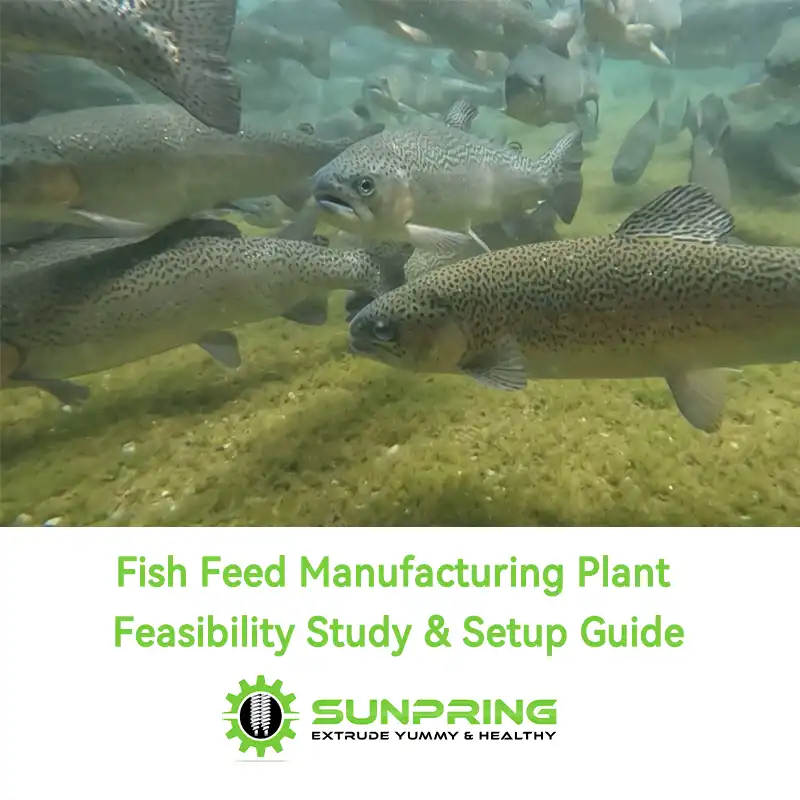
Fish Feed Manufacturing Plant
Feasibility Study & Setup Guide
A complete roadmap for building a floating and sinking fish feed plant with SunPring twin-screw and triple-screw extrusion lines — market outlook, manufacturing process, equipment selection, capital and operating costs, and financial projections.
Executive Summary
Growing market
The global fish feed market was valued at USD 24.80 billion in 2025 and is expected to reach USD 61.41 billion by 2034 (CAGR 10.6%, 2026–2034, IMARC estimates). Aquaculture now supplies more seafood for human consumption than capture fisheries.
Reference plant scale
This study models a mid-size reference plant of 20,000 MT/year (floating and sinking feed) running on SunPring extrusion lines. Start-up and industrial configurations are also presented.
Payback estimate
Using conservative assumptions (60% start-up utilization, USD 750/MT average selling price), the reference plant reaches break-even in year 2 and pays back within 3–4 years.
Market Analysis & Outlook
Global fish feed market size
USD billion · 2025 base = 24.80, CAGR 10.6% to 2034 (IMARC Group DPR). Intermediate years derived from the stated CAGR.
Independent forecasts compared
Annual growth estimates vary by scope (fish feed vs. aquafeed) and base year. All sources project sustained mid-to-high single-digit growth.
Demand drivers
- Aquaculture expansion: farmed aquatic animals hit 103.3 million MT in 2024, surpassing wild catch for the first time (FAO).
- Protein demand: urbanization (≈45% of 8.2 billion people) and rising incomes push consumption of affordable high-protein food (IMARC).
- Feed conversion: extruded floating/sinking pellets cut feed waste vs. mash, raising demand for processed feed.
- Regional growth: China aquafeed ≈ USD 17.9bn (2024) → USD 25.5bn by 2029 (MarketsandMarkets); Vietnam USD 4.2bn → USD 6.5bn.
Key applications & buyers
- Aquaculture farms — commercial fish and shrimp operations (largest volume).
- Hatcheries — starter and nursery feeds for juveniles.
- Ornamental fish farms — color-enhancing, immune-supporting formulas.
- Global players: Cargill, Zeigler Bros., ADM, Alltech, Skretting (IMARC) — room remains for regional low-cost producers.
Product Range & Positioning
| Product | Typical pellet size | Density | Target species | Key process window |
|---|---|---|---|---|
| Floating extruded feed | 0.8–12 mm | 0.7–1.0 g/cm³ | Tilapia, carp, trout, catfish | Starch 15–20%, temp 110–150°C, floats 2–24 h |
| Sinking extruded feed | 2–8 mm | 1.1–1.4 g/cm³ | Shrimp, bottom feeders, eel | Starch 10–18%, temp 90–130°C, water stable 2–4 h+ |
| Shrimp / crustacean feed | 0.8–2.5 mm | Sinking | Shrimp, crab, lobster | Slow-sinking, high water stability |
| Starter / micro feed | 0.1–1.5 mm | Floating or sinking | Fry, fingerlings | Fine grinding, uniform particle size |
Manufacturing Process
The process flow follows the standard DPR structure for extruded aquafeed: raw-material handling through to packaged goods.
Capacity & SunPring Equipment Selection
Three plant configurations are proposed, each built around a SunPring extruder series. All three run both floating and sinking feed.
| Configuration | Annual capacity | Extruder line | Model example | Best for |
|---|---|---|---|---|
| Start-up / SME | 2,000–8,000 MT | SP classic twin-screw | SP500S · SP800S (30–45 kW) | New entrants, farm co-ops, low budget |
| Mid-size (reference) | 15,000–30,000 MT | EC new twin-screw | EC2500S · EC3500S (110–132 kW) | Regional feed mills, multi-product flexibility |
| Industrial | 40,000–60,000 MT+ | ECTS triple-screw | ECTS3500S · ECTS5500S | Large plants, energy-cost-sensitive markets |
Classic twin-screw
Proven and economical. 100–5,500 kg/h, forced oil-lube gearbox, Cr12MoV screws HRC62, self-cleaning, diesel option. Lowest running cost.
New twin-screw
Flexible and modular. 80–8,000 kg/h, extendable barrel, steam preconditioner, touchscreen PLC, handles plant protein and fresh meat.
Triple-screw
Energy-efficient and high-output. 1,000–8,000 kg/h, 20–40% less energy and up to +50% output vs. same-power twin-screw, up to 3,000 rpm.
Raw Materials & Utilities
Main raw materials
- Fishmeal — primary protein source; price volatility is the key cost risk (USD 1,200–1,500/MT in 2024, USDA).
- Soybean meal — main plant-protein replacement; less volatile than fishmeal.
- Wheat / corn — starch source for gelatinization and pellet binding.
- Binders, oils, additives — vitamins, minerals, enzymes, pigments, functional boosters.
Raw materials typically account for 75–85% of operating expenditure (IMARC) — secure long-term supply contracts before commissioning.
Utility requirements (per ton of feed)
| Utility | Typical consumption | Share of OpEx |
|---|---|---|
| Electricity | 90–160 kWh/MT (extrusion, drying) | ~5–8% |
| Steam | 0.2–0.4 t/MT (conditioning) | included above |
| Water | 0.4–0.8 m³/MT | <1% |
| Manpower | 12–18 operators (reference plant) | ~4–6% |
ECTS triple-screw cuts electricity per ton by 20–40% — the largest utility lever in an extrusion plant.
Capital Investment (CapEx)
Reference plant (20,000 MT/yr) — cost build-up
| Item | USD | % of CapEx |
|---|---|---|
| Extrusion line (SunPring) | on request | 35–45% |
| Ancillary equipment (grinder, mixer, dryer, cooler, coating, packaging) | est. 0.9–1.3 mn | ~35% |
| Building & civil works | est. 0.5–0.7 mn | ~20% |
| Installation, commissioning, training | est. 0.2–0.3 mn | ~7% |
| Working capital buffer (90 days) | est. 0.6–0.8 mn | — |
SunPring line pricing is quotation-based; request a formal quotation for the exact model mix. Ranges are planning estimates benchmarked against published industry data.
CapEx allocation
Illustrative allocation for a 20,000 MT/yr plant, excluding working capital. Extrusion line share confirmed on quotation.
Operating Expenditure (OpEx)
Cost structure at 85% utilization
Raw materials 75–85% of OpEx per IMARC; utilities 5–10%. Structure shown is a planning estimate.
Why raw-material cost dominates
Feed formulation cost tracks fishmeal and soybean meal markets. Practical mitigations:
- Long-term supply contracts with nearby millers (IMARC recommendation).
- Formula flexibility: EC/ECTS lines run higher plant-protein inclusion (pulses, oilseed meals).
- Energy efficiency: ECTS saves 20–40% electricity per ton — meaningful at 85% utilization.
- Yield & durability control in QC reduces pellet fines and rework.
Financial Projections
| Year | Utilization | Revenue (USD mn) | Gross profit | Net profit (USD mn) | Net margin |
|---|---|---|---|---|---|
| Year 1 | 60% | 9.0 | ~20% | 0.4–0.7 | ~5–8% |
| Year 2 | 75% | 11.3 | ~24% | 0.9–1.3 | ~8–11% |
| Year 3 | 85% | 12.8 | ~26% | 1.3–1.8 | ~10–14% |
| Year 4 | 85% | 13.0 | ~27% | 1.4–1.9 | ~11–15% |
| Year 5 | 85% | 13.3 | ~28% | 1.5–2.0 | ~11–15% |
Break-even
Operating break-even reached in year 2 as utilization passes ~70%.
Payback
Cumulative net profit covers CapEx within 3–4 years under base case.
Gross margin
Consistent with IMARC benchmarks for healthy extruded-feed operations.
Regulatory & Environmental Compliance
Food safety & quality
- HACCP plan with CCP monitoring (moisture, temperature, density).
- ISO 9001 quality system; traceability from batch to bag.
- SunPring equipment is built to CE / SGS / ISO9001 standards.
- Export markets: check country feed-safety registration (e.g., EU, Türkiye, MENA).
Environment
- Dust collection on grinding/mixing to keep emissions within limits.
- Effluent treatment for washdown water (IMARC requirement).
- Energy monitoring — ECTS lines reduce kWh/MT, supporting green credentials.
- Zoning and permits confirmed before site purchase (IMARC step 1).
Implementation Roadmap
Contact SunPring Today
Send Inquiry Now
Click to connect with SunPring, our quick-response customer service will contact you soon. 100% Promise!