


Artificial Rice Making Machine
Artificial Rice Making Machine — Turnkey FRK Production Line
From broken rice to vitamin-fortified kernels in one twin-screw line: grinding, mixing, extrusion, drying, cooling and packing. Capacity 5–2,500 kg/h, with the recipe parameters your national fortified-rice standard requires.
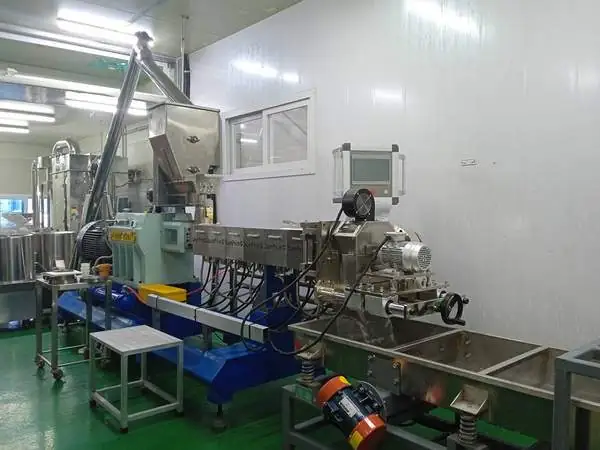
What Is Artificial Rice / Fortified Rice Kernel?
Artificial rice — also sold as nutrition rice, analog rice or fortified rice kernel (FRK) — is a rice-shaped grain produced by extrusion cooking rather than by milling paddy.
Rice flour, broken-rice powder, millet, corn or tapioca starch is blended with a vitamin-mineral premix (vitamin A, B1, B2, B3, B12, folic acid, iron, zinc, calcium) and water. The dough is cooked and shaped through a twin-screw extruder and a rice-profile die, then dried to a stable moisture so the kernel keeps its shape through storage and transport.
The fortified kernels are later dry-blended with ordinary white rice at 0.5%–2% — roughly 1 kg FRK per 50–100 kg of plain rice — to produce fortified rice that meets national standards such as FSSAI in India. Because the micronutrients are locked inside the extruded kernel, they survive washing, soaking and cooking instead of leaching into the rinse water.
That is why the same machine is used for three different business models: government and school-meal fortification programmes, premium retail nutrition rice, and low-carb or specialty rice such as konjac rice.
8 Types of Fortified Rice Kernels This Machine Can Produce
Change the flour base, the premix and the die profile, and the same twin-screw platform runs the full fortified-rice family. Recipe parameters are stored in the PLC, so switching products is a one-touch changeover.




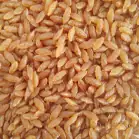

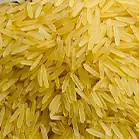

Why Invest in an Artificial Rice Making Machine?
Nutrition 5–10× higher
Vitamins, iron, zinc and calcium are dosed during extrusion and sealed inside the kernel. One serving of blended rice delivers several times the micronutrients of plain white rice, meeting government fortification standards.
Upgrade broken rice value
Broken rice is the cheapest fraction of every rice mill. Instead of selling it as animal feed, re-extrude it into rice-shaped kernels sold at a premium — the margin sits in the conversion, not in the raw material.
Institutional demand
India, Indonesia, the Philippines and Nigeria now mandate fortified rice in public distribution and school meals. Suppliers who can hold a consistent kernel quality win repeat tender business.
Not sure which model fits your target output? Send us the capacity and raw material — we return the model list and line scope, not a single-machine price.
Get a line layout & quotation →Who buys an FRK line
PDS and school-meal fortification: FSSAI-compliant kernels at tender volume, with batch-to-batch colour and density consistency.
Premium fortified and specialty rice packs, where kernel appearance and cooking behaviour decide repeat purchase.
Buyers who need a line that can be replicated across multiple plants and documented for cross-border supply.
Konjac rice, low-GI blends and instant rice — same platform, different die and premix.
4 Key Points About the Artificial Rice Extruder
01 · Market fit
Full use of the rice crop, high nutrient density per serving and growing demand for nutritious staples are what drive the category. Confirm first whether your market is a government programme, a retail brand, or both — the packing and blending sections differ.
02 · Raw materials
Base: rice flour or broken-rice powder. Add a vitamin-mineral premix (iron, folic acid, B12, zinc, vitamin A) to the level your national standard specifies. Millet, corn, wheat and tapioca starch are used for cost or texture adjustment.
03 · Machine components
Live-bottom feeder, twin-screw extruder, rice-profile die head, air conveyor, multi-layer dryer, cooling conveyor and automatic packing machine. The extruder and die set the kernel shape; the dryer sets the shelf life.
04 · Cooking behaviour
FRK needs no special recipe. Rinse and cook it with your normal rice routine — texture, aroma and cooking time stay unchanged once the kernels are blended at the correct ratio.
Fortified Rice Kernel Production Line — 6 Steps
A complete FRK line is six unit operations. Every section is sized from the extruder output, so the capacity you choose at the die determines the grinder, mixer, dryer and packing machine behind it.
Grinding & Mixing
Rice and broken rice are ground to flour, then blended with premix and water into a uniform dough in a ribbon mixer.
Screw Conveying
The dough is fed to the extruder hopper continuously and dust-free, keeping the die pressure stable across the shift.
Twin-Screw Extrusion
Cooking, shearing and shaping happen here. Screw profile and barrel temperature decide kernel density, colour and cook behaviour.
Core machineAir Conveying
Wet kernels are lifted to the dryer inlet without mechanical damage, so surface starch stays intact.
Multi-Layer Dryer
Hot-air drying brings moisture down to ≤10% in controlled stages, which is what gives the kernel its shelf life.
Cooling & Packing
Kernels cool to room temperature, then are weighed and bagged — 25 kg, 50 kg or retail packs depending on your market.
Fortified Rice Kernels Production Line Layout
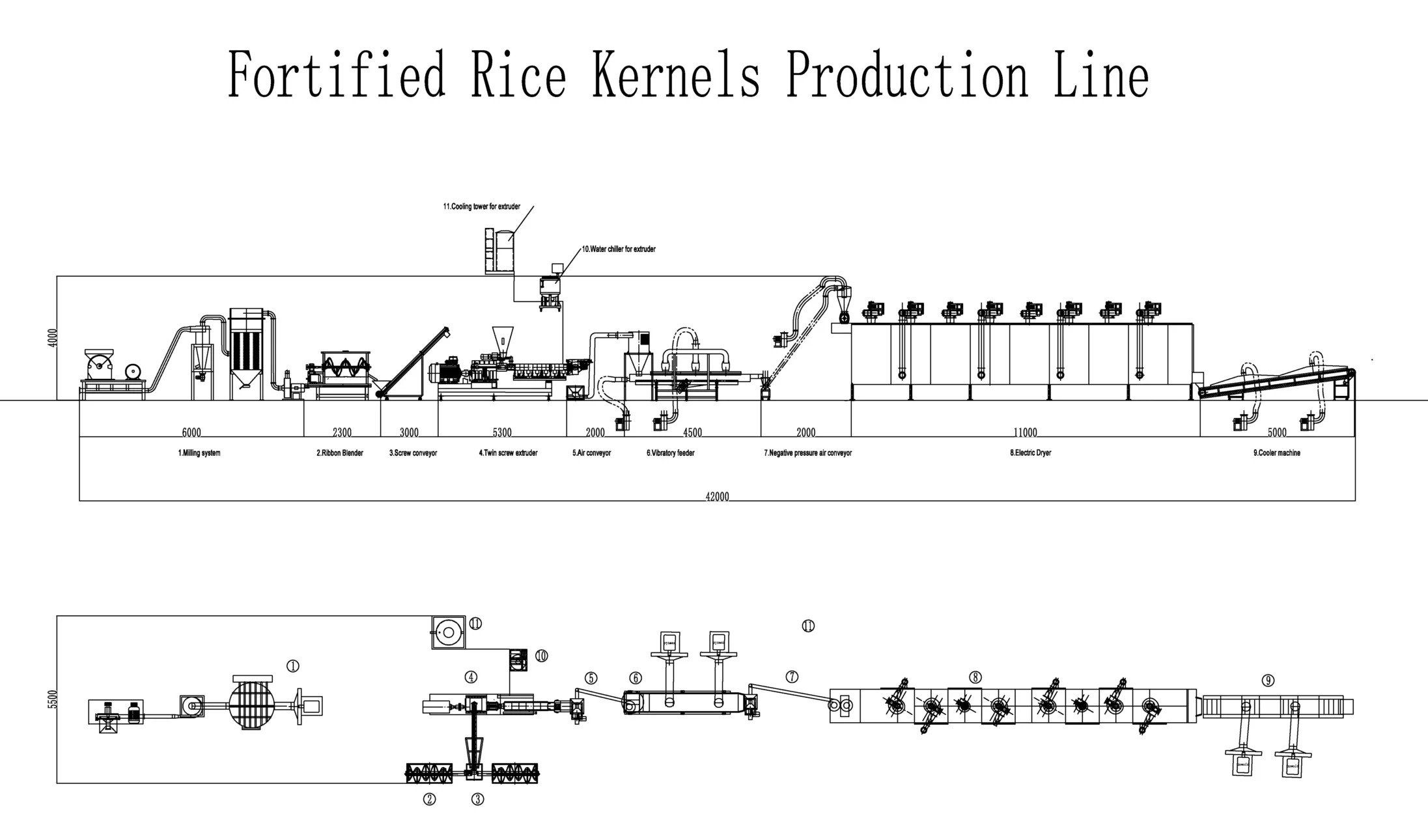
What a complete FRK line includes
Every section below is quoted as one package — you buy a working line, not a stack of separate machines.
| Stage | Equipment | Function |
|---|---|---|
| Grinding | Hammer mill / pin mill | Grinds broken rice and rice into fine flour for extrusion |
| Mixing | Ribbon blender | Blends flour, vitamin-mineral premix and water into uniform dough |
| Feeding | Screw conveyor + live-bottom hopper | Continuous, dust-free feed at stable pressure |
| Extrusion | Twin-screw extruder | Cooks, shears and shapes the dough — the core machine |
| Shaping | Rice-profile die head | Sets kernel length, width, density and cook behaviour |
| Conveying | Air conveyor | Moves wet kernels to the dryer without surface damage |
| Drying | Multi-layer hot-air dryer | Brings moisture to ≤10% for shelf life and transport |
| Cooling | Cooling conveyor | Cools kernels to room temperature before packing |
| Packing | Automatic weighing & bagging | 25 kg / 50 kg bags or retail packs, weight-consistent |
| Control | PLC + HMI touchscreen | Stores up to 50 recipes; one-touch product changeover |
Artificial Rice Extruder Models & Capacity (5–5,000 kg/h)
Nine models cover lab trials to industrial tender supply. Every frame is SUS304, 1.2 mm food-contact sheet, with Siemens main motor and Delta inverter as standard.
| Specification | EC-lab | EC200R | EC300R | EC500R | EC800R | EC1500R | EC2500R | EC3500R | EC5500R |
|---|---|---|---|---|---|---|---|---|---|
| Motor power | 5.5 kW | 22 kW | 45 kW | 75 kW | 90 / 110 kW | 110 / 132 kW | 132 / 160 kW | 160 / 200 kW | 250 / 375 kW |
| Capacity (kg/h) | 5–50 | 50–200 | 150–300 | 300–500 | 600–900 | 900–1,800 | 1,500–2,500 | 2,000–3,600 | 3,500–5,000 |
| Typical application | Lab / R&D | Small plant | Small plant | Medium plant | Medium plant | Industrial | Industrial | Large industrial | Large industrial |
How to pick a model: start from daily output — a 200–500 kg/h line (EC200R–EC500R) covers an entry commercial plant; 1,500–2,500 kg/h (EC1500R–EC2500R) matches tender-scale supply; EC-lab at 5–50 kg/h is for recipe development before you commit capital.
All machines use #304 stainless steel, 1.2 mm food-contact sheet. Main motor Siemens; electricals Siemens / CHNT; inverter Delta. Capacity figures are for fortified rice kernels and shift with product density and die profile — confirm your target output and we will size the complete line around it.
Artificial Rice Machine Photos
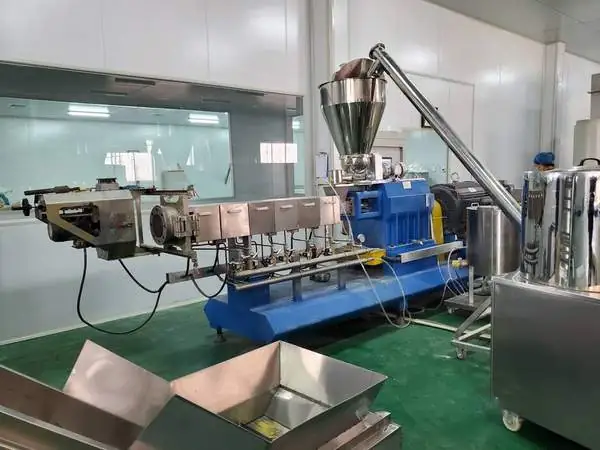
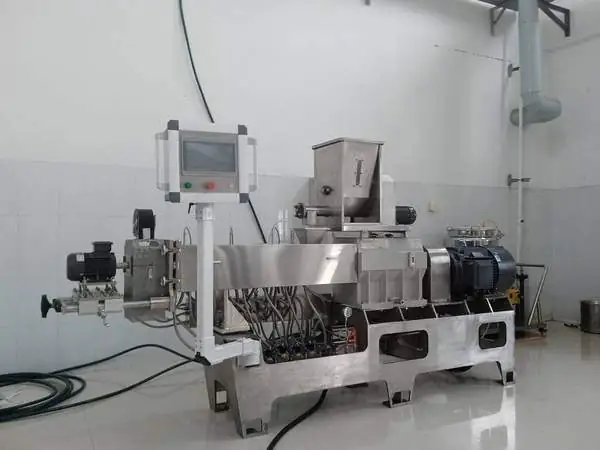
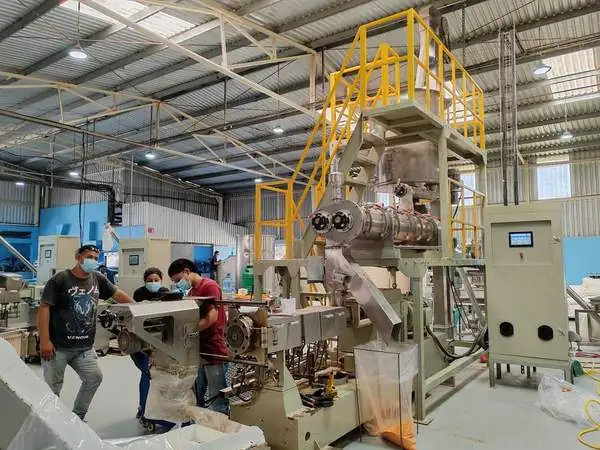
Watch the Artificial Rice Machine in Action
Three short clips: kernel forming at the die, line commissioning abroad, and the finished kernels cooking like ordinary rice.
Why Choose a SunPring Artificial Rice Machine?
The extruder is the easy part to copy. What decides whether your line hits rated output on day 30 is the die design, the drying curve and the recipe support behind it.
All food-contact parts in SUS304, 1.2 mm sheet — food-grade and easy to clean between products.
Main drive and electricals from named brands, specified for continuous two- and three-shift operation.
Grinding, mixing, extrusion, drying, cooling and packing from one contract, one warranty and one service contact.
We share proven premix dosing and process parameters for FSSAI-compliant fortified rice, not just a machine manual.
From EC-lab for R&D to EC5500R for large industrial supply — sized to your market instead of the nearest stock size.
Twin-screw geometry and barrel temperature zoning cut kWh per kilogram compared with conventional cooking-extrusion layouts.
FRK lines running in India, Costa Rica, Nigeria, Egypt and Indonesia, with more than 100 extruders sold in India alone.
Our engineers attend installation, commissioning and trial production, and train your operators until the line reaches target output.
PLC stores up to 50 product recipes — FRK, konjac rice, golden rice and cereal — switchable without re-tuning the barrel.
Screw segments, barrel liners and die heads held in stock and dispatched worldwide, so a wear part never stops a shift.
CE-marked machines from an ISO 9001 factory, packed for sea freight with export documentation.
Send 5 kg of your local raw material; we run it on our lab extruder and return the kernels for your own lab test.
SunPring Fortified Rice Machine — Global Projects
From a 50 kg/h lab extruder for product development to a 2,500 kg/h industrial FRK plant feeding a government tender, the same platform travels.
FRK lines for FSSAI-compliant school-meal and PDS programmes; 100+ extruders sold across the market.
Largest installed baseNutrition rice project running since 2011 — one of our earliest fortified rice references.
Since 2011Fortified maize-rice blending lines for institutional supply and retail packing.
Maize-rice blendsPremium fortified rice under local beras formulas, packed for retail distribution.
Retail gradeLines are also running in the Philippines, Thailand and Russia. Every project ships with line layout drawings, an operation manual, a spare-parts list and remote PLC support for process tuning.
Customer Feedback on the Fortified Rice Machine
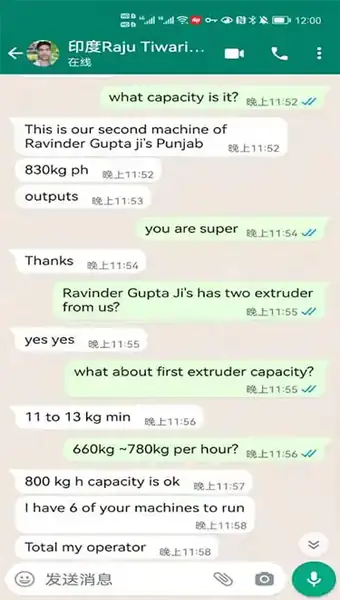
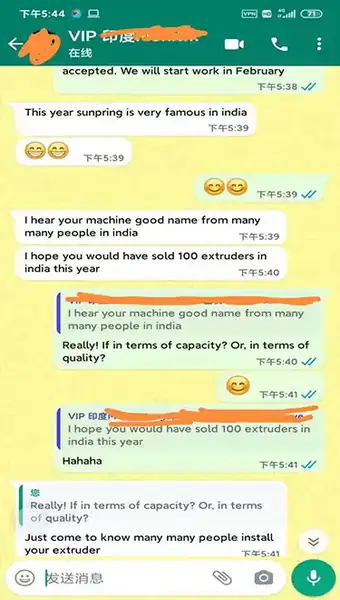
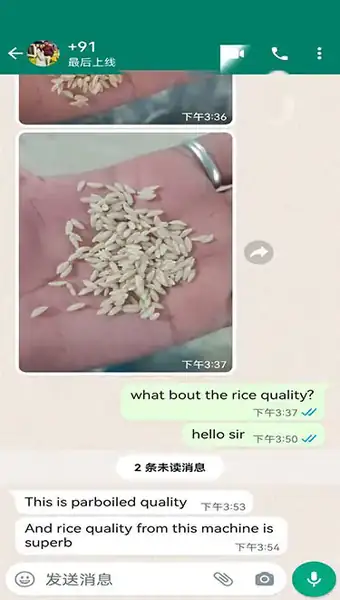
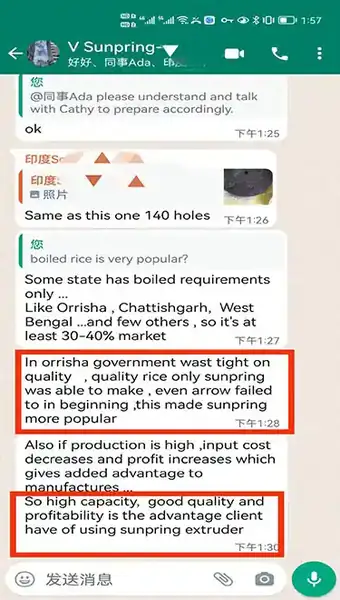
These are transcribed from WhatsApp conversations with FRK producers, dealers and distributors in India — the market where most SunPring artificial rice lines run. Two of the producers below already operate more than one SunPring extruder.
“This is our second machine from SunPring here in Punjab — 830 kg/h output. I have six of your machines to run.”Raju Tiwari · FRK producer, Punjab, India
“In Orissa the government is tight on quality. Quality rice only SunPring could make in the beginning — that is what made the brand popular here.”Dealer · Orissa, India
“High capacity, good quality and profitability — that is the advantage clients have with the SunPring extruder.”Dealer · Chhattisgarh, India
“Now SunPring is the top brand in India — all clients need it. Take care of your dealers, they work hard to make a brand succeed.”Dealer · India
“You have topped the Indian market this year — congratulations. All in India ask for SunPring now.”Distributor · India
“This year SunPring is very famous in India. I hear your machine's good name from many people; many people install your extruder.”VIP dealer · India
Original WhatsApp screenshots


Want to see the line before you decide? Book a sample trial on your own broken rice — kernels come back tested, so the quotation is based on your material, not ours.
Book a sample trial →From Enquiry to Production — Six Steps
Requirement review
Target output, raw material, product mix, voltage and destination port — the five inputs that size the line.
Line layout & quotation
You receive a model list, a line scope and a layout drawing matched to your building, not a single machine price.
Sample trial
Optional but recommended: run your own raw material on the lab extruder and test the kernels before committing.
Manufacture & test
Machines are built, assembled and run-tested in our factory before crating for sea freight.
Installation & training
Engineers attend site for mechanical installation, commissioning and operator training through trial production.
After-sales
12-month warranty on the main extruder, remote PLC tuning, WhatsApp support and spare parts dispatched from stock.
Other Lines Built on the Same Twin-Screw Platform
If your market also needs rice flour, starch, cereal or snack pellets, the same twin-screw platform covers those products — only the screw profile, die and downstream drying change.
Frequently Asked Questions
1. What is the full form of FRK?
FRK stands for Fortified Rice Kernel — rice-shaped kernels carrying a prescribed micronutrient mix such as iron, folic acid and vitamin B12. FRK is blended into ordinary rice at roughly 1:100 to 1:200 before packing.
2. How is artificial rice manufactured?
Broken rice and rice are ground to flour, mixed with water and a vitamin-mineral premix into dough, then cooked and shaped through a twin-screw extruder and a rice-profile die. The wet kernels are dried to ≤10% moisture, cooled and packed.
3. What is the raw material for artificial rice?
Main materials are broken rice, rice flour, millet, corn flour, wheat flour or tapioca starch. The vitamin-mineral premix — vitamin A, B1, B2, B3, B12, folic acid, iron, zinc, calcium — is dosed to your national standard.
4. Does fortified rice taste different?
No. Fortified rice needs no special recipe: rinse and cook it exactly as you cook ordinary rice. Cooking time, flavour, texture and aroma stay the same once the kernels are blended at the correct ratio.
5. What does an FRK plant cost?
Cost depends on capacity, line configuration and destination. A 150–300 kg/h line and a 1,500–2,500 kg/h industrial plant are different projects entirely. Send your target output and raw material and we reply with a model list and full line quotation.
6. Can the same extruder make breakfast cereal or snacks?
Yes. With a different screw configuration and die set, the same twin-screw platform runs corn flakes, breakfast cereal and puffed snacks — useful if you want one machine covering several SKUs.
7. How much does one artificial rice making machine cost?
The machine price moves with capacity, configuration and port of destination. Tell us your target output, local voltage and nearest port, and the quotation we return covers the machine, the auxiliary sections and freight assumptions.
8. How long does installation and commissioning take?
Mechanical installation, commissioning and operator training are handled by our engineers on site. The exact schedule is fixed in the contract once the line scope and site readiness are confirmed, so it matches your building programme.
9. Can I test a sample before ordering?
Yes. Send about 5 kg of your local raw material; we run it on the lab extruder and ship the finished kernels back, so your own laboratory can check colour, density and cooking behaviour.
10. What warranty and after-sales support is included?
A 12-month warranty on the main extruder, English operation manuals, video guides, WhatsApp support and spare parts dispatched from stock. Remote PLC programming is available for process tuning after start-up.
11. What is the difference between FRK and fortified rice?
FRK is the extruded kernel itself. Fortified rice is the finished product you pack and sell: 0.5–2% FRK dry-blended into ordinary white rice, so the blend meets the nutrient level your standard requires.
12. What capacity do I need for a commercial FRK plant?
Work backwards from daily tonnage. A 200–500 kg/h line suits an entry commercial plant, 1,500–2,500 kg/h suits tender-scale supply, and the 5–50 kg/h lab unit is for recipe development and sample approval.
13. What power supply and floor area does a line need?
It depends on the model and the drying configuration. Before you commit, we send a layout drawing with installed power, air consumption and the floor area your building has to provide.
14. Can the line run on 100% broken rice?
Yes. Broken rice is the standard base material. Rice flour, millet, corn or tapioca starch are added for cost or texture, and the vitamin-mineral premix sets the nutritional claim.
15. Which certificates are available for export?
CE-marked machines from an ISO 9001 factory, with export packing and shipping documents — including certificate of origin — prepared for your destination market.
Get Your Artificial Rice Plant Solution
Tell us your target capacity and raw material. We send a line layout, machine list and quotation — no catalogue dump, no guesswork on your building.
What to include in your enquiry
- Target output — kg/h or tons per day, and how many shifts.
- Raw material — broken rice, rice flour, millet or a blend, plus the premix you plan to use.
- Product mix — FRK only, or also konjac rice, golden rice or instant rice.
- Site conditions — local voltage, available floor area and nearest port.
We reply with the model list, line scope and layout drawing, usually within one business day. Sample testing on your own raw material can be arranged before you commit.